What Is AI Chatbot Technology and How Does It Work?
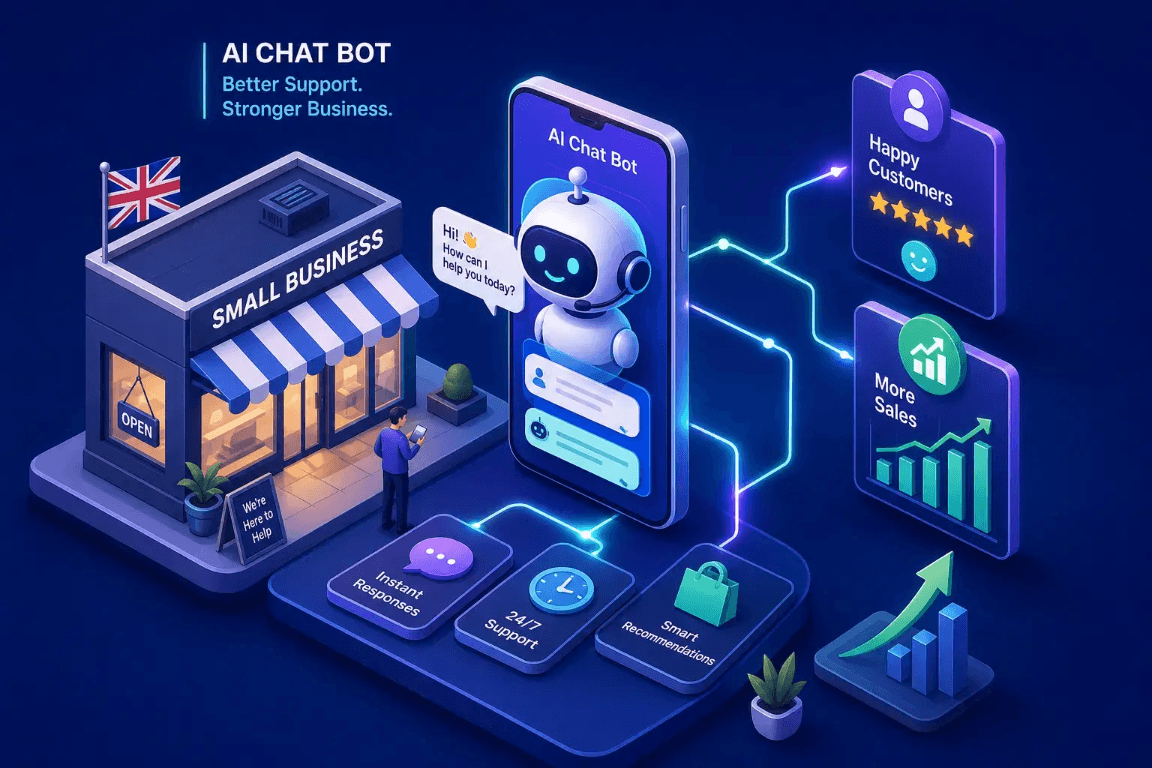
AI chatbots are software tools that understand natural-language messages and reply conversationally through a widget on your website, app or messaging channel. UK small businesses use them to handle routine customer queries, capture leads overnight, automate FAQ responses and free staff time without adding headcount.
The technology has matured quickly, and getting something live with a no-code platform or embed script is often possible within a day, depending on the complexity of the setup. The sections below explain how chatbots work, where they can help, how to compare platforms, what UK GDPR means for a deployment and which KPIs can show whether the bot is earning its place.
Chatbot, Virtual Assistant and Conversational AI: What Is the Difference?
These terms appear interchangeably in vendor marketing, but they describe different things. An AI chatbot is the user-facing application embedded on a website or messaging channel. It is focused on answering questions or completing defined tasks, such as handling a return-policy query or booking an appointment. A virtual assistant is broader: it maintains context across systems, can schedule meetings, retrieve account data and execute actions on behalf of a user. Conversational AI is the underlying technology platform that powers both.
A practical way to think about it: the chat widget your customer types into is the chatbot. The software infrastructure containing language models, integrations, dialogue management and analytics is the conversational AI platform. When a vendor sells you a "virtual assistant," they usually mean something that goes further than answering FAQs and can act across connected systems. Knowing the distinction helps you ask the right questions before you buy.
How Language Models and RAG Give Modern Chatbots Their Intelligence
Modern AI chatbots run on large language models (LLMs) trained on vast text datasets. When a customer sends a message, the model reads it, uses the conversation context and generates a fluent, relevant reply one word at a time. That is why responses feel natural rather than scripted. The limitation is that an LLM's knowledge is fixed at its training cutoff and does not include your specific policies, pricing or product details.
Retrieval-augmented generation (RAG) addresses this limitation. With RAG, the chatbot indexes your own documents, FAQs, policy documents and product descriptions, then retrieves relevant passages before generating an answer. The result is a bot that can reply using your information rather than relying only on general knowledge. A well-configured RAG setup helps distinguish a business chatbot grounded in its source material from one that may confidently give the wrong answer.
Which Tasks Should UK Small Businesses Use AI Chatbots For?
The strongest use case for most small businesses is handling questions that come in repeatedly: opening hours, pricing, delivery times, returns policies and basic troubleshooting. A chatbot can handle these at any time, including overnight or on a bank holiday, without making customers wait for a member of staff.
Consider a customer asking about a return window. Without a chatbot, the query waits until a staff member is available. With a well-configured bot drawing from the returns policy page, the customer can get an answer in seconds. After-hours capture can also help small teams log and acknowledge leads and enquiries for follow-up the next morning.
Lead-qualification flows are another use case. The bot asks a few structured questions about budget, location, service needed and timing, then routes a qualified prospect to a salesperson. Appointment scheduling works similarly: the bot handles triage and diary checks, while a human handles the conversation that matters.
For accountancy practices or subscription-based businesses, simple account queries, such as asking when a payment is due or what a current balance is, may also be automated with the right system integration. The bot connects to the relevant data source, retrieves the answer and responds, freeing staff for work that requires human judgement.
Choosing an AI Chatbot Platform for a UK Small Business
General consumer tools such as ChatGPT, Claude and Gemini are excellent for internal tasks like drafting emails, summarising documents and preparing briefings. In their standard consumer form, however, they are rarely the right fit for a customer-facing widget on a website. They are designed as general-purpose assistants rather than embeddable chatbot apps trained on your specific data and connected to your booking system.
Before ruling those tools out entirely, check each provider's API, enterprise and embedding options; the landscape is evolving quickly and purpose-built integrations do exist. Platforms worth evaluating for a small business website include Chatbase, Tidio with its Lyro AI layer, ManyChat, Landbot and Botpress. Each suits a different business profile, so choose based on your customer channels, integrations and technical confidence rather than marketing claims.
Prices are frequently quoted in US dollars and vary with annual billing, usage volumes and agent-seat counts. Before committing to a plan, check whether AI resolution costs are included in the subscription or charged separately. Also verify whether a data-processing agreement is available for your specific plan and region.
Finding a Developer or Agency to Build Your Solution
Many small business owners do not want to configure a chatbot platform themselves, and that is entirely reasonable. Selecting a platform is one step; integrating it with a CRM, booking system or ecommerce store is another. This is where a skilled developer or digital agency can help.
Company83 is building a UK business directory for web designers, developers and digital marketing agencies. As profiles are published, they are checked against public information and include a last-checked date to help readers assess how current the information is.
What Does UK GDPR Mean for Your AI Chat Service?
Customers routinely share more than they intend to when typing into a chat widget. Health conditions, financial details, account numbers and personal identifiers can appear in support conversations. If messages are logged, retained or used to train a provider's model without customers understanding that, you may have a compliance problem before the chatbot has answered a single query.
Cross-border data processing is common among US-based chatbot vendors and requires appropriate safeguards under UK GDPR. You remain responsible for understanding what is collected, why it is collected, how long it is retained and where it goes. Treating this as a box to tick after launch is the wrong approach.
Practical Controls to Put in Place Before Going Live
Before switching on the widget, confirm that your vendor offers a data-processing agreement and put appropriate terms in place. Disable provider use of customer conversations for model training unless you have a clear lawful basis and have disclosed that use to customers. Set a documented retention period for chat logs rather than allowing indefinite storage.
Add a clear privacy notice to the chatbot widget that tells users they are interacting with AI and explains how their data is handled. If the chatbot will handle sensitive data or process information at significant scale, assess whether a Data Protection Impact Assessment is appropriate before launch.
The ICO's AI and data-protection guidance applies standard UK GDPR principles to chatbot deployments rather than creating a separate compliance regime. Building appropriate controls in from the start is generally simpler than retrofitting them after a complaint.
How Do You Know If Your AI Chatbot Is Delivering Results?
Counting total chatbot conversations tells you little about whether a deployment is working. Set a baseline for each relevant metric during the four to eight weeks before launch, long enough to capture a representative sample, so you have a reference point for changes afterwards.
- Resolution rate: the percentage of queries resolved without a human agent.
- Escalation rate: whether the fallback to a human is working correctly.
- First-response time.
- Lead-qualification rate for bots handling lead generation.
- Booking or conversion rate.
- Customer satisfaction score.
Prompt Examples and Realistic Benchmarks
Resolution rate and customer satisfaction should be tracked together. A high resolution rate alongside falling satisfaction can mean the bot is closing conversations without actually helping customers. Escalation rate also shows whether customers are reaching a useful outcome when the bot cannot help.
Two prompts worth testing in a configuration are: "If a customer asks about our returns policy, retrieve the relevant section from our returns page and confirm the timeframe clearly." For a lead-qualification flow: "Ask the customer for their postcode, the service they need, their approximate budget, and their preferred timeframe, then confirm you will pass the details to the team." Both are narrow, testable and easy to check against actual policies.
Vendor case studies quote resolution rates of 80–86% for routine enquiries handled without an agent, but these figures reflect optimised deployments with well-maintained knowledge bases. Treat them as an upper bound rather than a baseline expectation. Results in the first month depend on the knowledge base, the predictability of customer queries and how clearly a resolved conversation is defined. Begin with a small set of common questions, measure for four weeks and expand only when accuracy and resolution metrics are stable.
Getting Started: The Practical Path Forward
AI chatbots are a practical, measurable tool for UK small businesses, not necessarily a complex or expensive technology project. The clearest wins are in customer support automation, lead capture and after-hours coverage. A focused deployment can deliver more value than an ambitious multi-channel rollout that nobody has time to manage properly.
Choosing the right chatbot app matters less than starting with a focused use case and tracking whether the conversational agent resolves queries or just handles volume. A narrow FAQ bot with a solid knowledge base, data-processing terms and a clear privacy notice is a stronger foundation than a feature-rich deployment that nobody has properly configured.
Company83 is developing a directory of UK developers and digital marketing agencies. Browse its published profiles as they become available, compare providers and read editorial guides on AI automation before commissioning work. Getting the right agency involved early can help avoid unnecessary setup and integration work.
How Quickly Can We Get an AI Chatbot Live on Our Website?
You can often get a chatbot live within a day, depending on the complexity of your setup. No-code platforms or an embed script make rapid deployments possible, though integrations and more complex configurations will take longer.
Who Is the Data Controller for Chatbot Conversations Under UK GDPR?
You are generally the data controller for conversations that pass through your chatbot. That responsibility does not transfer to the vendor, so establish the appropriate data-processing terms, document retention periods and provide a privacy notice before going live.
Are Consumer Tools Like ChatGPT Suitable as an Embeddable Customer-Facing Widget?
In their standard consumer form they are rarely the right fit for a website widget. They can be useful for internal tasks, but for a customer-facing bot check each provider's API, enterprise and embedding options, and consider purpose-built chatbot platforms.
15-Prompt AI SEO & Operational Engine
Test how Company83 subscribers analyze live ranking volatility and operational bottlenecks with actionable, plain-English execution steps.
Executive Analysis
Model: Gemini 1.5 Flash • Context: UK SERP IngestionPrimary keyword position slipped due to competitor mobile LCP speed optimizations (sub-0.9s) and updated LocalBusiness JSON-LD markup.
🎯 Suggested Site Actions
- Update LocalBusiness schema with explicit service area coordinates and verified aggregate ratings.
- Compress hero assets on the boiler installation landing page to bring LCP under 0.8 seconds.
- Add a targeted FAQ section answering 'Emergency commercial boiler repairs in Bristol' to target AI Overviews.
💡 Commercial Opportunity
Top competitor lacks verified E-E-A-T credentials and business directory verification. Claiming a verified Company83 profile reclaims local authority signals.
Need deeper competitive intelligence and automated recovery? Book a £50 Custom AI Research Audit to receive an end-to-end engineering blueprint.
Book £50 AI Research Audit →